
Top Strategies for Nutrition and Brain Health for Aging Adults
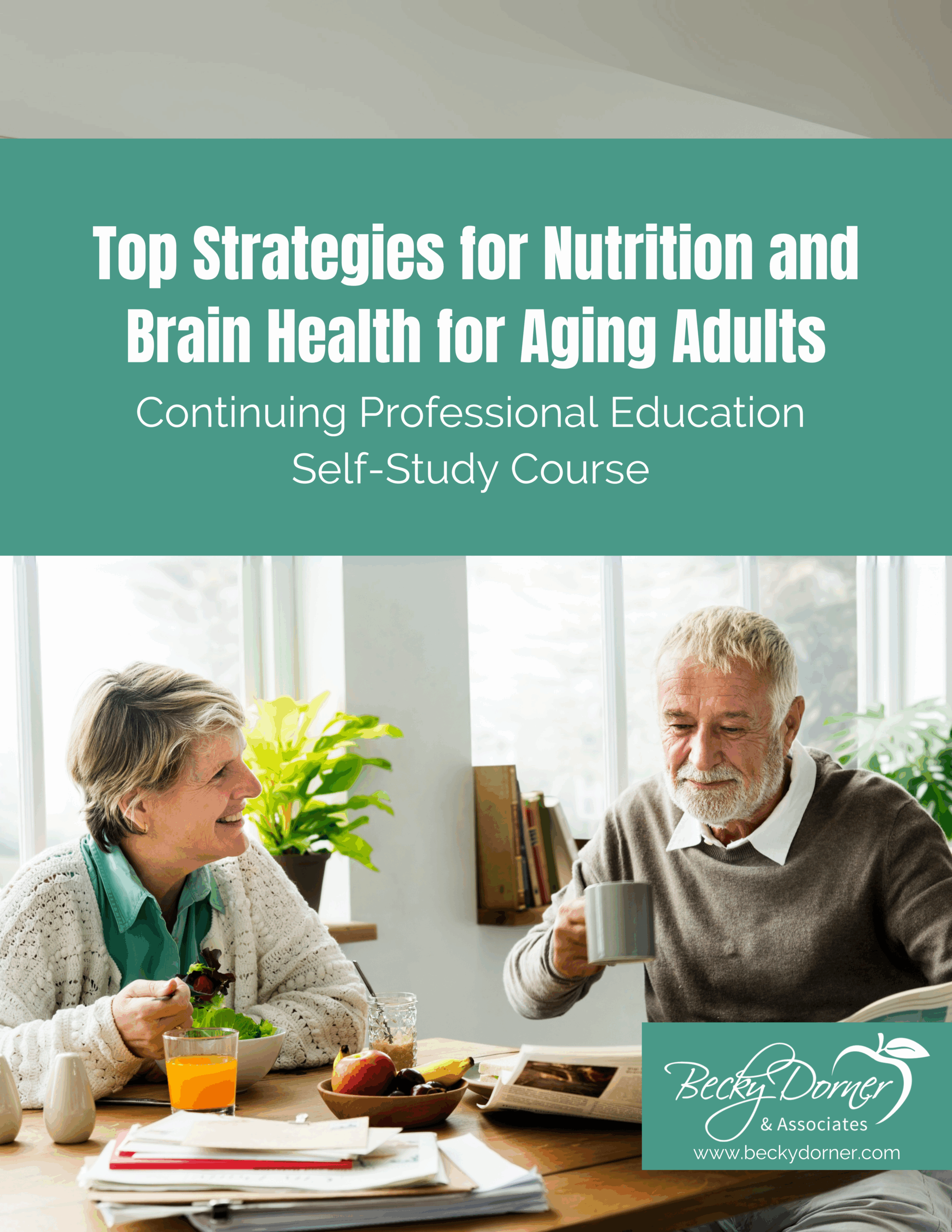

Purchase this Product
Learn to critically interpret and apply current literature to support nutrition and brain health in older adults!
Course Description
This continuing education program explores emerging research on the relationship between nutrition and brain health in older adults. Through a series of evidence-based articles and multiple choice questions, participants will examine key findings related to specific nutrients, supplementation, and cognitive outcomes. The program is designed to strengthen the participant’s ability to critically interpret and apply current literature to support the nutritional needs of aging populations.
The content aligns with key professional competencies, including:
- Evaluating and Addressing Health Disparities: Participants will consider how social determinants of health—such as socioeconomic status, food access, and education—contribute to inequities in nutrition and brain health among older adults.
- Applying Evidence-Based Standards: Learners will analyze findings from systematic reviews and clinical studies to support evidence-based decision-making in nutrition care for aging populations.
- Prioritizing Nutrition Concerns in Care Planning: The program encourages the identification and prioritization of nutrition-related issues, particularly those affecting cognitive function and quality of life, to inform individualized care planning and treatment.
This course is appropriate for registered dietitian nutritionists (RDNs) and nutrition and dietetic technicians, registered (NDTRs) that are employed in skilled nursing facilities and hospitals or for nutrition practitioners who help support healthy aging.
Purchasing Options: This is available as eDocument plus CPE Test only. Includes a link to the required reading in the course document, electronic test, and 1 certificate with passing grade.
After completion of this CPE program, the participants will be able to:
- Evaluate and address inequity and health disparities associated with social determinants of health regarding nutrition, brain health, and aging.
- Tailor messages and communication methods to meet the needs of the older adult population.
- Interpret and apply appropriate evidence-based literature and standards for determining nutritional needs of aging adults.
- Prioritize specific nutrition problems to inform nutrition care plans.
This course is intended for: RDNs and NDTRs
Top Strategies for Nutrition and Brain Health for Aging Adults awards 3 CPEUs in accordance with the Commission on Dietetic Registration CPEU Approval.
CDR Activity Number: 189544 Self Study Activity Type: 741 Enduring Activity
CPE Level: II
Suggested CDR Performance Indicators:
-
-
-
- 2.3.3 Evaluates and addresses inequity and health disparities associated with social determinants of health.
- 3.1.3 Tailors messages and communication methods to meet the needs of target audiences.
- 9.1.1 Interprets and applies the appropriate evidence-based literature and standards for determining nutritional needs of target audiences.
- 11.3.3 Prioritizes specific nutrition problems to inform nutrition care plans and processes.
-
-
This self-study course includes required reading, a downloadable course document and an online exam with multiple choice questions. Upon passing the test, the learner can download and print the certificate.
Required Reading for this Course:
Insights and Implications in Gerontology: The Vital Role of Nutrition in Brain Health. Gerontological Society of America. March 2024. And Strategies to Support Adequate Nutrition in Older Adults: Proceedings From a Roundtable. Gerontological Society of America. 2024. (A link to the articles is included in the downloadable course document).
Disclaimer: The text associated with this course is required solely for the course taker to learn the underlying principles that will be applied in taking a case-study based exam. Neither the authors nor the publishers of the text/book have contributed to or endorsed this course.
Praise for Becky Dorner & Associates
Plate to Planet: Impact of Food Choices on the Planet course
Stacey Phillips, MS, RD
State Operations Manual Appendix PP- Guidance to Surveyors for Long Term Care Facilities Course
Doreen Rodo, MEd, RDN, LDN
Managing Chronic Kidney Disease with the Nutrition Care Process Course
Stacey Phillips, MS, RD
Developing Leadership and Management Skills in Nutrition and Dietetics
Amy Hess-Fischl, MS, RDN, LDN, BC-ADM, CDCES
Aimee Shea, MPH, RDN, CCMS, LD
Plate to Planet: Impact of Food Choices on the Planet course
Janice Baker, MBA, RDN, CDCES, CNSC, BCADM
Related Products
Popular Products
Join Our FREE eNewsletter & Create An Account
Get 20% off your first order and receive regular updates and new product announcements! Create an account now.