The Eating Disorder Guidebook Self Study Course
Emma Fogt, EdD, MBA, RDN, FAND
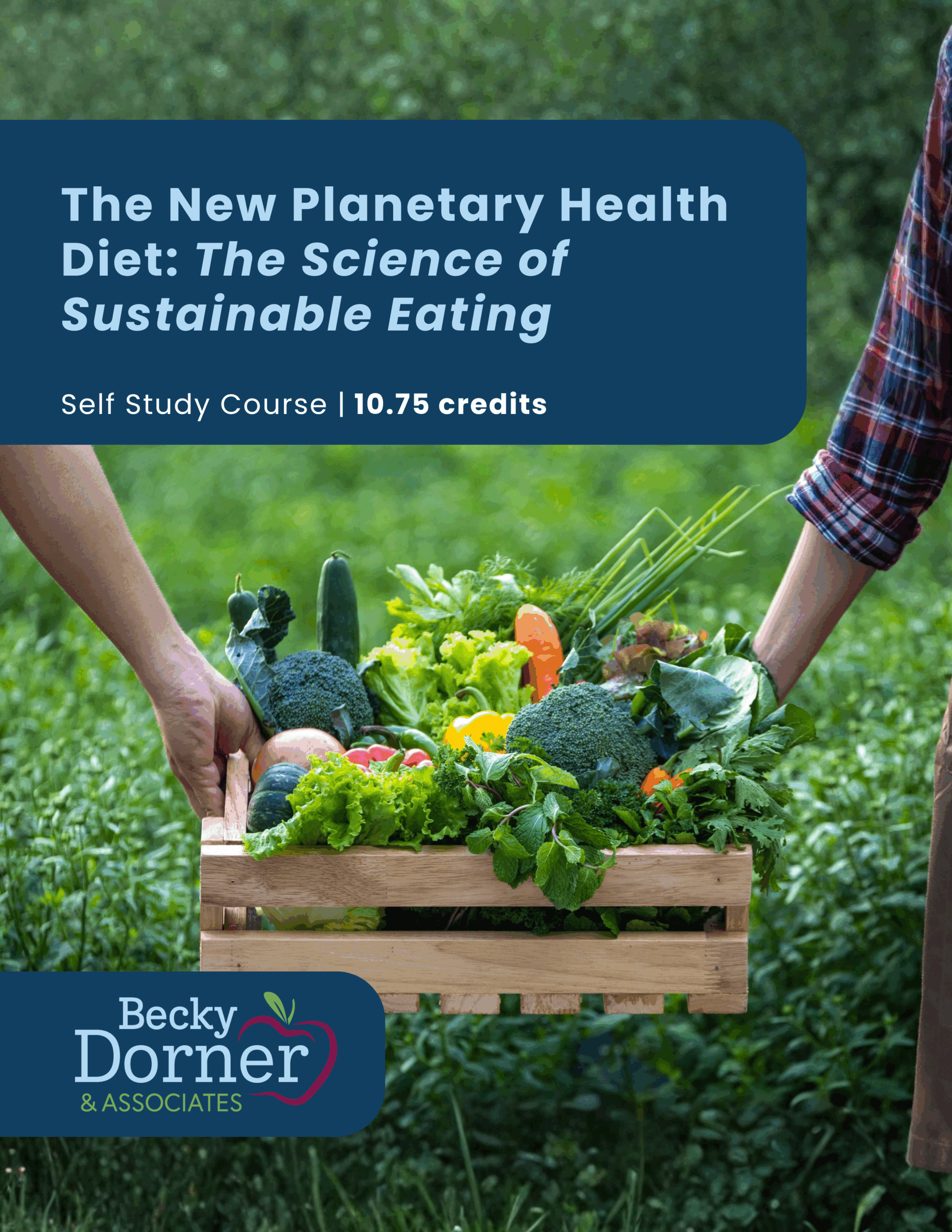
The New Planetary Health Diet: The Science of Sustainable Eating

Purchase this Product
This case-based self study course delves into concepts including real life scenarios, research, farming practices, food justice, and systems change.
The advanced course examines how global food systems interact with planetary environmental boundaries, human health and social justice. The course focuses on current and future equitable access to nutritious food around the world while respecting environmental limits. Complex challenges related to greenhouse gas emissions, blue water use, nitrogen and phosphorus are explored throughout the course.
The course delves into eight priority solutions to improve health, environmental sustainability and justice comparing “business as usual” scenarios with forecasted year 2050 models. Human rights for food, decent work, and the right to a healthy environment are discussed in detail around the globe.
This course is supported by almost 600 references and over 35 tables, figures, and charts illustrate points from adult diets around the globe, justice frameworks, environmental impacts on food systems; and goals, solutions, and actions to achieve healthy, sustainable, and just food systems.
Four case studies support the course concepts in real life scenarios, research, farming practices, food justice, and systems change.
This course is appropriate for registered dietitian nutritionists (RDNs) and nutrition and dietetic technicians, registered (NDTRs) that are employed in hospitals and outpatient facilities as well as in public health, policy, and educational arenas.
Course includes electronic document, electronic test and 1 certificate with passing grade.

After completing this continuing professional education course, the learner should be able to:
- Integrate new knowledge and skills related to sustainable food systems into practice.
- Develop and disseminate knowledge on global health systems related to planetary diet and health to enable advocacy for local state and national policies to reduce health disparities and increase nutrition security.
- Disseminate research findings on climate change, food sustainability, equity, and justice for the future of our health and planet.
- Identify and prioritize global dietary and agricultural issues for sustainable food systems.
This course is intended for: RDNs and NDTRs
The New Planetary Health Diet: The Science of Sustainable Eating awards 10.75 CPEUs in accordance with the Commission on Dietetic Registration CPEU Approval.
This course has also been approved for the required 1 health equity CPEU.
CDR Activity Number: 192005 Self Study Activity Type: 741 Enduring Activity
CPE Level: II
Suggested CDR Performance Indicators:
- 1.1.5 Integrates new knowledge and skills into practice.
- 2.4.1 Develops and disseminates knowledge to enable advocacy for local, state, and national policies and programs to reduce nutrition and health disparities and increase nutrition security throughout the lifecycle.
- 7.3.1 Disseminates research findings to support knowledge translation.
- 13.4.5 Identifies and prioritizes agricultural issues and takes action to ensure sustainable food systems, prevention and wellness programs.
Note: Numerous other Performance Indicators may apply.
This self-study course includes required reading, a downloadable course document and an online exam with multiple choice, case study based questions. Upon passing the test, the learner can download and print the certificate.
Required Reading for this Course: The EAT- Lancet Commission on healthy, sustainable, and just food systems. The Lancet.
Disclaimer: The text associated with this course is required solely for the course taker to learn the underlying principles that will be applied in taking a case-study based exam. Neither the authors nor the publishers of the text/book have contributed to or endorsed this course.
Praise for Becky Dorner & Associates
Change in Body Size and Mortality Among Healthy Older Adults
Kate Willcutts, DCN, RDN, CNSC, FASPEN
Managing Chronic Kidney Disease with the Nutrition Care Process Course
Stacey Phillips, MS, RD
Ethics Isn’t Optional: Understanding and Applying the Academy of Nutrition and Dietetics Code of Ethics-2nd Edition
Brenda Richardson, MA, RDN, LD, FAND
Emma Fogt, EdD, MBA, RDN, FAND
Policy & Procedure Manual: For Nutrition and Food Service in Healthcare Facilities, 2023
Katy Adams, MDA, RD, CSG, LD