Food-shaping is often overlooked in aged care facilities. Many facilities could easily adapt several food-shaping techniques that are discussed in this short course to improve the nutrition outcomes of their older adults with dysphagia.
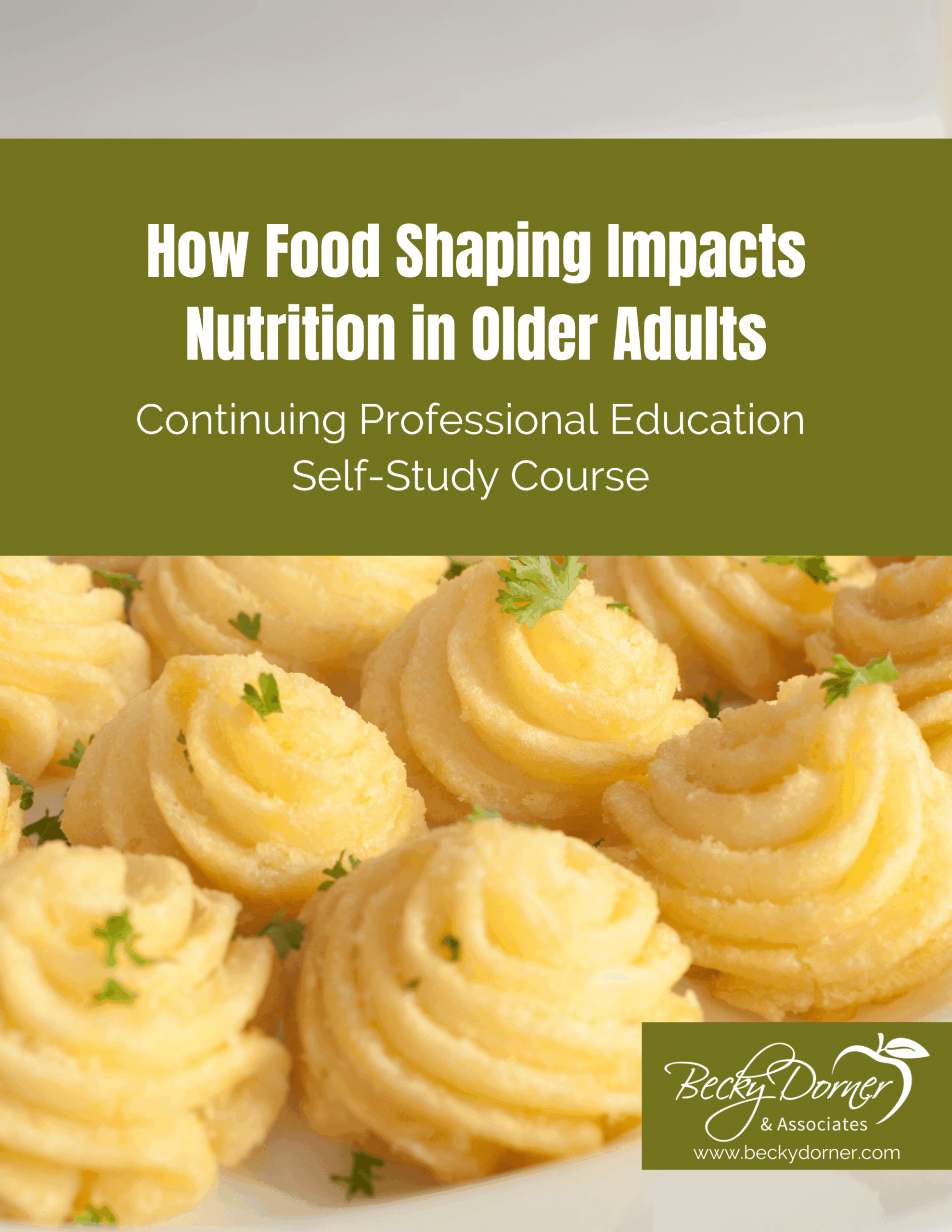
How Food Shaping Impacts Nutrition in Older Adults

Purchase this Product
Learn how food shaping can improve the appearance, acceptability, and overall quality of life in older adults with swallowing difficulties!
The required reading for this course was published in 2023 and was written by three authors who work in healthcare settings with older adults in dietetics, speech pathology, and nursing. The inclusion criteria for the systematic review included only peer reviewed research published in English in the past 20 years.
Food-shaping includes methods such as piping food through piping bags with shaped tips, using food molds, ice cream scoops, and even 3D printers to manipulate the appearance and shape of mechanically altered food. The purpose of food shaping is to improve the appearance, acceptability, and overall quality of life in older adults with swallowing difficulties.
This review found a total of 18 studies that met these inclusion criteria. The review included those with mixed methods, qualitative and quantitative study designs. The types of food shaping included in these studies are 3D food printing, general food-shaping, food molds, scoops, layering, and addition of sauces.
This course is appropriate for registered dietitian nutritionists (RDNs) and nutrition and dietetic technicians, registered (NDTRs) that are employed in aged care settings including assisted living, independent living, skilled nursing, and home health.
Purchasing Options: This is available as eDocument plus CPE Test only. Includes a link to the required reading in the course document, electronic test, and 1 certificate with passing grade.

After completing this continuing professional education course, the learner should be able to:
- Evaluate the chemical nature and composition of food on food quality, acceptability, and compatibility to inform product development, menu planning and food preparation techniques.
- Develop or modify recipes, menus, and meals using sensory perception and other food components.
- Use a variety of cooking techniques, food preparation methods and production and delivery systems.
- Participate in ongoing evaluation of menu items, quality of products, costs, nutritional goals and requirements.
This course is intended for: RDNs and NDTRs
CDR Activity Number: 185541 Self Study Activity Type: 741 Enduring Activity
CPE Level: II
Suggested CDR Performance Indicators:
-
-
- 9.1.3 Evaluates the chemical nature and composition of food-on-food quality, acceptability, and compatibility to inform product development, menu planning and food preparation techniques.
- 9.5.2 Develops or modifies recipes, menus, and meals using sensory perception and other food components.
- 9.5.3 Uses a variety of cooking techniques, food preparation methods and production and delivery systems.
- 14.2.5 Participates in ongoing evaluation of menu items, quality of products, costs, nutritional goals and requirements.
-
Note: Numerous other Performance Indicators may apply.
This self-study course includes required reading, a downloadable course document and an online exam with multiple choice questions. Upon passing the test, the learner can download and print the certificate.
Required Reading for this Course: The Impact of Food-Shaping Techniques on Nutrition, Mealtime Experiences, and Quality of Life for Older Adults in Aged Care Settings: A Systemic Review. Current Nutrition Reports (a link to the article is included in the downloadable course document).
Disclaimer: The text associated with this course is required solely for the course taker to learn the underlying principles that will be applied in taking a case-study based exam. Neither the authors nor the publishers of the text/book have contributed to or endorsed this course.
Praise for Becky Dorner & Associates
Blue Zones: Keys to Longevity Course
Sue Linja, RDN, LD
Blue Zones: Keys to Longevity Course
Sue Linja, RDN, LD
Diabetes and Pregnancy: A Nutrition Update
Amy Hess-Fischl, RDN, CDCES
Diabetes and Pregnancy: A Nutrition Update
Amy Hess-Fischl, RDN, CDCES
Food Code 2022 Course
Linda Eck Mills, MBA, RDN, LDN, FADA
Food Code 2022 Course
Linda Eck Mills, MBA, RDN, LDN, FADA
GLP-1 Therapy for Patients with Obesity: Identifying Solutions to Optimize Nutrition
Aimee Shea, MPH, RDN, CCMS, LD
GLP-1 Therapy for Patients with Obesity: Identifying Solutions to Optimize Nutrition
Aimee Shea, MPH, RDN, CCMS, LD
A Dietitian’s Guide to Nutrition Care for Bariatric Surgery Self-Study Course
Janice Baker, RDN, CDCES, CNSC, BCADM
A Dietitian’s Guide to Nutrition Care for Bariatric Surgery Self-Study Course
Janice Baker, RDN, CDCES, CNSC, BCADM
Sports Nutrition for the Nutrition Professional Course
Leslie Bonci, MPH, RDN, CSSD, LDN, FAND
Sports Nutrition for the Nutrition Professional Course
Leslie Bonci, MPH, RDN, CSSD, LDN, FAND


Reviews
There are no reviews yet.