
BDA courses are well written and make learning effective and applicable to clinical practice. Because they use a case study approach, the course tests are applicable to real life clinical practice.
NEW!
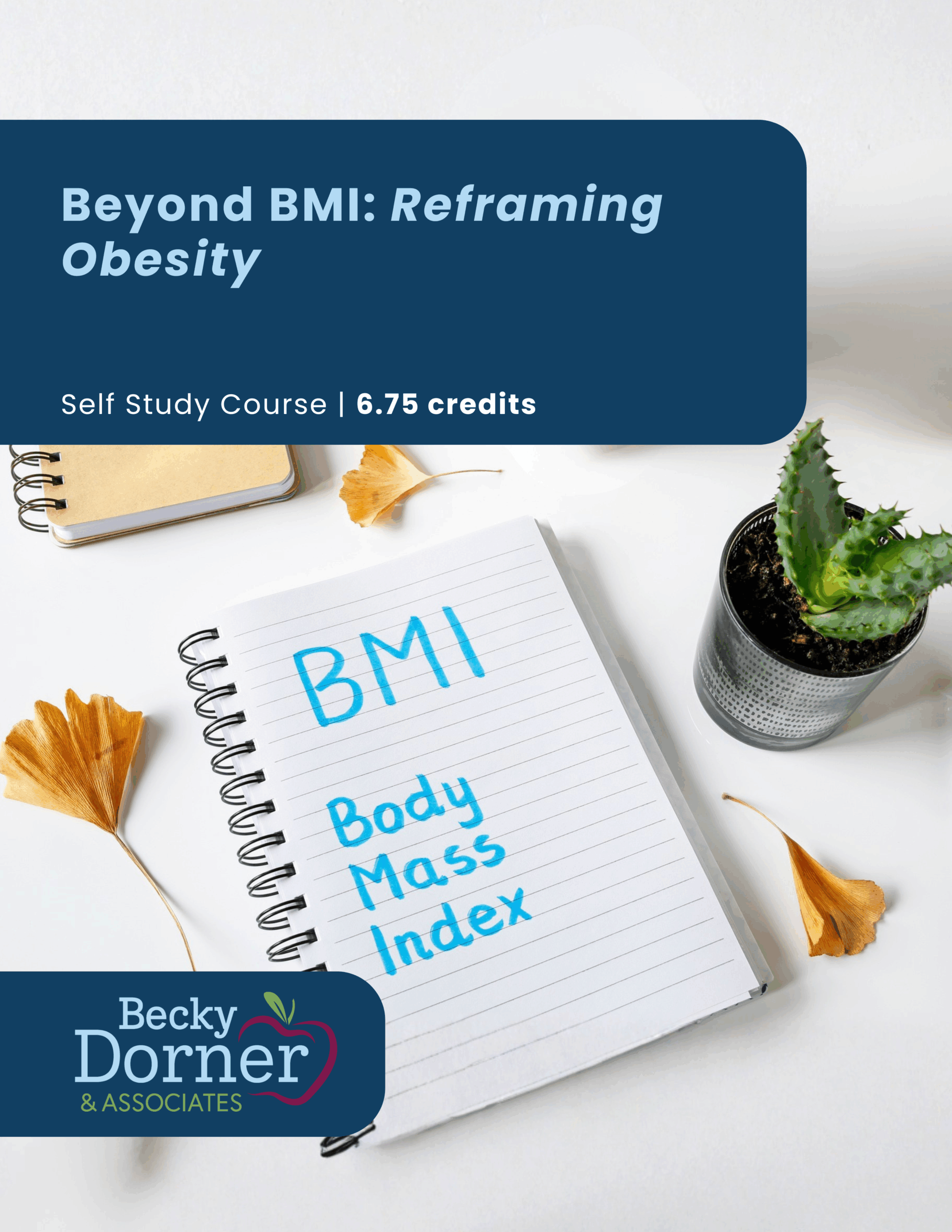
Beyond BMI: Reframing Obesity

Course Expires January 23, 2029
Credits: 6.75 CPE
Profession:
RDN/NDTR
Required Reading 1
Purchase this Product
Gain insight into diagnostic approaches and weight management options for obesity with this case-based self study course!
The required reading for this course is in alignment with recent recommendations from an international commission to provide a consensus framework for evaluating how new diagnostic parameters for obesity may inform clinical interventions, policy development, and medical education. The curriculum includes discussion of obesity as an illness with the goal of differentiating preclinical obesity from clinical obesity across the lifespan (adults, adolescents and children).
Participants will gain valuable insight into diagnostic approaches, conceptual debates, and practical clinical interpretation of obesity on stigma, policy, and clinical work. Participants will examine the complex interplay between hormonal, metabolic, and physiological mechanisms of obesity including the brain, muscle, liver, cardiovascular, lymphatic, respiratory, and reproductive systems. Case studies support concepts around obesity criteria, daily life, and weight management options as well as preclinical and clinical diagnoses in adult and pediatric cases.
The advanced course encourages critical thinking about definitions and reframing of obesity from a policy perspective, position paper, and overall clinical guidelines, and supplies almost 200 current references to support evidence-based discussion. Controversies and gaps in current obesity care are addressed in detail.
This course is appropriate for registered dietitian nutritionists (RDNs) and nutrition and dietetic technicians, registered (NDTRs) that are employed in hospitals, outpatient, and long-term care facilities as well as in public health and educational arenas.
Course includes eDocument (including a link to the required reading in the course document), electronic test and 1 certificate with passing grade.
After completion of this CPE program, the participants will be able to:
- Integrate new knowledge and skills related to defining obesity into practice.
- Interpret and integrate evidence-based research and literature in decision making as it relates to obesity.
- Use accepted benchmarking and best practices to inform practice in defining clinical and pre-clinical obesity.
- Prioritize specific nutrition problems related to obesity, illness and activities to inform nutrition care plans and processes.
This course is intended for: RDNs and NDTRs
Beyond BMI: Reframing Obesity awards 6.75 CPEUs in accordance with the Commission on Dietetic Registration CPEU Approval.
CDR Activity Number: 191360 Self Study Activity Type: 741 Enduring
CDR Course Level: II
Suggested CDR Performance Indicators:
- 1.1.5 Integrates new knowledge and skills into practice.
- 5.1.2 Interprets and integrates evidence-based research and literature in decision making.
- 8.4.7 Uses accepted benchmarking and best practices to inform practice.
- 11.3.3 Prioritizes specific nutrition problems to inform nutrition care plans and processes.
Numerous other Performance Indicators may apply.
This self-study course includes required reading, a downloadable course document, and an online exam with multiple choice, case study based questions. Upon passing the test, the learner can download and print the certificate.
Required Reading for this Course: Definition and diagnostic criteria of clinical obesity. Lancet Diabetes- Endocrinology 2024 (a link to the required reading is included in the downloadable course document).
Disclaimer: The text associated with this course is required solely for the course taker to learn the underlying principles that will be applied in taking a case-study based exam. Neither the authors nor the publishers of the text/book have contributed to or endorsed this course.
Praise for Becky Dorner & Associates
This makes an excellent CPE program! If a clinician learns everything in this program, I could consider them educated in the top 99% of all RDNs for the prevention and treatment of pressure injuries.
Nutrition Guidelines for the Prevention and Treatment of Pressure Ulcers/Injuries 2023 Course
Sue Linja, RDN. LD
Becky Dorner & Associates programs provide evidence-based continuing education for food and nutrition professionals. The courses cover cutting edge topics that will assist practitioners in various work settings.
Caryn Heller, RDN, LD
RDs often find themselves in scenarios where they will be coaching staff and/or patients. In addition, career planning and success may involve the use of an individual having the proper coaching skills. This CPE program provides information of not only how coaching…
Developing Coaching Skills: A Concise Introduction
Brenda Richardson, MA, RDN, LDN, FAND
I have years of experience consulting in long-term care and have frequently turned to the RAI Manual to guide my MDS coding. This course is essential for any LTC dietitian who hasn’t mastered the proper MDS coding process. The study materials were…
Minimum Data Set 3.0 Resident Assessment Instrument Manual v1.19.1 (October 2024) Self-Study Course
Doreen Rodo, MEd, RDN, LDN
We often hear mixed messages about plant-based diets. “They are super healthy.” “They aren’t healthy at all.” This self study course provides the opportunity to examine the available research on low-fat plant-based vegan diets and see the evidence firsthand. Clinicians will be…
Low-Fat Vegan Diet and Metabolic Health in Overweight Adults
Lori Stevens, RD, LDN
This required reading and self study course provides excellent information, varied topics, applicable to multiple healthcare venues and level of practitioners. It includes wonderful case studies as an excellent means to apply the information.
The Dietitian’s Guide to Nutrition Assessment Course
Katy Adams, MDA, RD, CSG, LD
Related Products


NEW!

Popular Products
✨ BOGO!
Join Our FREE eNewsletter & Create An Account
Get 20% off your first order and receive regular updates and new product announcements! Create an account now.