


Common Questions/Answers
Food Safety Citations
What are some common citations related to food safety, and can you give suggestions on how to avoid/correct them?
Examples of Common Citations Related to Food Safety (F812)
- Frozen hamburger thawing on the counter
- Not obtaining and/or recording food temps
- Outdated food
- Food not labeled or dated
- Equipment soiled with food splatter and/or dried food debris
- Visual evidence of food debris in the handwashing sink
- Mold on the inside chute of the ice machine
- Dirty floors with spilled milk in the walk-in cooler
- Multiple uncovered, soiled trays left out overnight in the dining room
- Corrective Actions
All of the above are violations, according to the CMS State Operations Manual – Appendix PP (CMS SOM). The correct action for these issues is to:
- Familiarize yourself with the CMS State Operations Manual – Appendix PP Food and Nutrition Tags (CMS SOM – Appendix PP).
- Check your facility’s policy and procedure manual to find a procedure for the above situations.
- Inservice staff on the correct procedure for completing each task.
- Regularly monitor the staff’s compliance with the policy and procedure manual.
- Follow up and provide disciplinary action for failure to complete tasks per the facility policy and procedure manual.
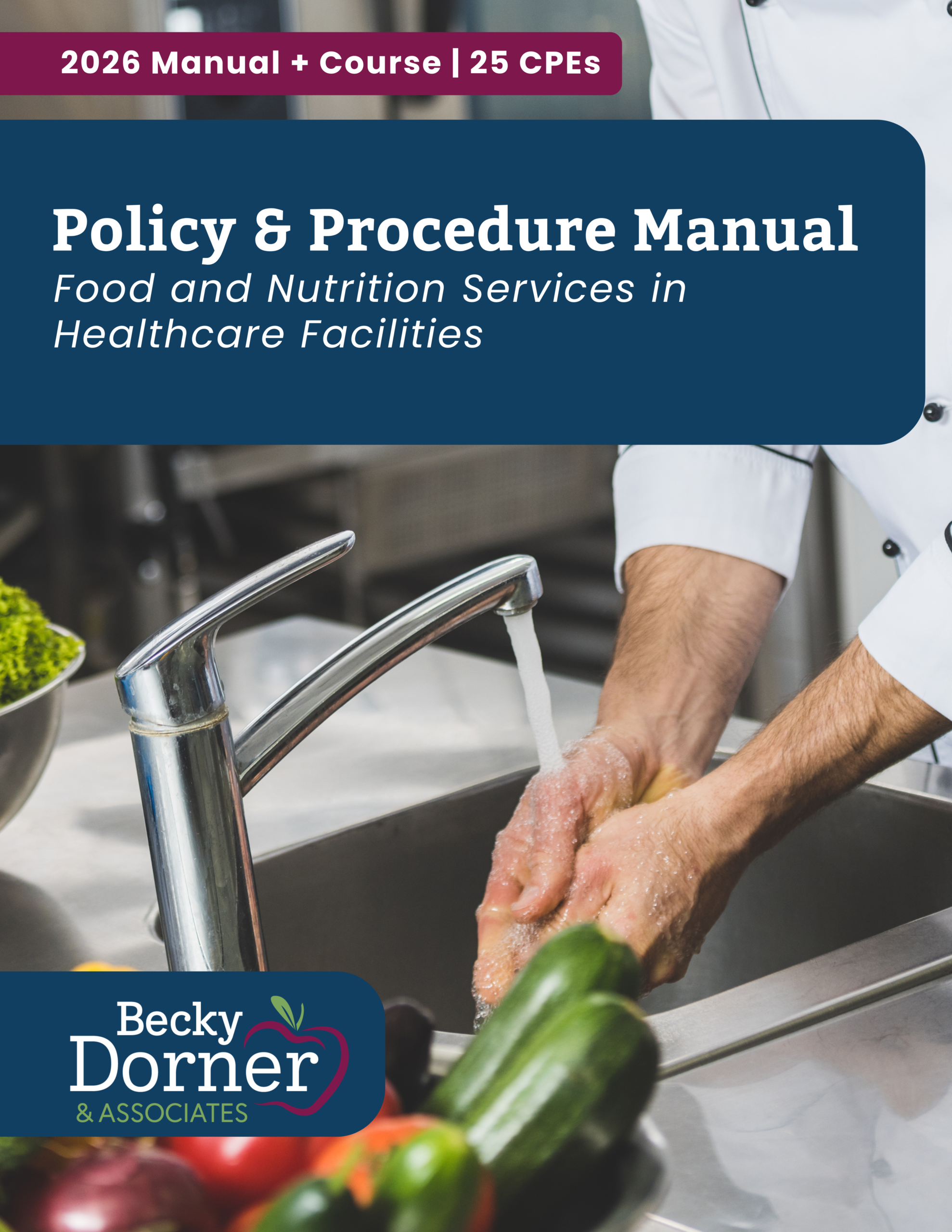
- Ensure recommendations are up to date. Consider purchasing our Policy & Procedure Manual if you do not have a current manual in your facility.
Best Practices
- Ensure that all equipment is on a weekly cleaning list.
- Implement and monitor systems for checking food temperatures to keep food safe.
- Complete regular kitchen sanitation checks to ensure food safety practices are followed.
- Complete test trays on a weekly or monthly basis or per facility guidelines to assess for safe food temperatures.
Staffing
What are the qualifications for a dietary manager in a nursing facility?
If a qualified nutrition professional or dietitian is not employed full-time, the Director of Food and Nutrition Services must meet one of the criteria noted in F801 (PDF page 629) according to the CMS State Operations Manual – Appendix PP (CMS SOM). Below are the qualifications from the CMS SOM:
a. A certified dietary manager; or
b. A certified food service manager; or
c. Has similar national certification for food service management and safety from a national certifying body; or
d. Has an associate’s degree or higher in food service management or hospitality, if the course of study includes food service or restaurant management, from an accredited institution of higher learning; or
e. Has 2 or more years of experience in the position of director of food and nutrition services in a nursing facility setting and has completed a course of study in food safety management, by no later than October 1, 2023, but not limited to foodborne illness, sanitation procedures, and food purchasing/receiving; and
(ii) In States that have established standards for food service managers or dietary managers, meets State requirements for food service managers or dietary managers, and
(iii) Receives frequently scheduled consultations from a qualified dietitian or other clinically qualified professional.
If the manager does not meet qualifications a-d, they must meet (e). Some States have specific regulations. For example, in Ohio, the course of study in food safety is equivalent to ServSafe Level 2. A violation will ensue if the criteria is not met.
Food Temperatures
What should the food/beverage temperature be at the point of service in a nursing home?
Best practice and regulations mandate proper minimal internal cooking and holding temperatures to keep food safe. However, these temperature mandates are no longer in effect after the food leaves the serving line. F804 in the CMS State Operations Manual – Appendix PP for nursing homes states that a facility serving food and drink is “palatable, attractive, and at a safe and appetizing temperature.” The interpretive guidelines state: “Is food served at preferable temperature (hot foods are served hot and cold foods are served cold) in accordance with resident preferences? (Not to be confused with the proper holding temperature).” If you are not receiving complaints from residents about food temperatures, the temperatures are likely acceptable for your resident population’s preferences. However, it is best to ask residents on a regular basis to assure you don’t have any issues. It is also good practice to evaluate food temperatures using test trays periodically and to evaluate food temperature complaints promptly.
Leftovers
Can I use leftovers in my facility?
Any leftover food (food that was meant to be served for a meal, but not all served) should be used as follows: Leftovers should be covered, labeled, and dated, then stored appropriately (refrigerated or frozen) within 1 hour. Leftovers must be cooled to less than or equal to 41 degrees F within 4 hours. Leftovers must be reheated to 165 degrees for a minimum of 15 seconds and then held at the proper temperature for service (>135 degrees F). Using a cooling log to document that proper time and temperature control were achieved is best practice. Discard leftovers that were not handled according to appropriate food safety guidelines. Leftovers should not be used to make pureed food.
Policies & Procedures
I have been asked to update my facility’s policy and procedure manual for clinical nutrition. Do you have any ideas on what should be on the clinical side of the table of contents?
Our Policy & Procedure Manual is used in long term care facilities and hospitals across the U.S. You can view the table of contents on our website. It has a thorough nutrition care section. You might consider purchasing this manual for use in your facility – it comes with electronic files for ease of customization which is a huge time saver!
Date Marking
When labeling and dating foods, should we use a discard date on items, or label and date with the date the food was opened? What do most places do?
We would recommend that you check with your local regulatory authorities on this. Some jurisdictions recommend one procedure over another. One practice is to note a “discard by” date for the food so there is no mistake about how long it should be kept. The “opened on” dating system is also used, but may leave staff guessing when the product should be discarded. With either system, it’s smart to have the person who dates the food also add their initials to the label so if there are any questions, you can go back to that staff member for answers.
Facilities usually create a policy to determine how the dating is done in the food service department, and that is the way they train the staff. Whatever your facility decides, be consistent with it and make sure all staff follow the same procedure – especially ensuring that food is rotated and used before the discard by date.
Handwashing/Gloves
When should food service workers wear gloves?
F812 in the CMS State Operations Manual – Appendix PP states that employees should never use bare hand contact with any foods, ready-to-eat or otherwise. Gloves should be worn whenever a worker is directly handling a food item with bare hands. Always wash your hands before putting gloves on. Gloved hands are a food contact surface that can get contaminated or soiled. Gloves need to be changed whenever they touch any soiled item or contaminated surface, or after coughing or sneezing, touching another person or yourself, touching the table, picking something else up with the gloves, etc. Any time you change gloves, you should wash your hands.
Mechanically Altered Diet Citations
What are some common citations related to the mechanically altered diet F-tag and can you give suggestions on how to avoid/correct them?
Common Citations Related to Mechanically Altered Diets (F808):
- A mechanically altered diet is ordered, but a regular diet texture is served
- Incorrect pureed consistency is served
- Incorrect serving sizes provided
- Menu spreadsheets not followed for mechanically altered diets
- Recipes for pureed foods not followed
Corrective Actions
All of the above are violations, according to the CMS State Operations Manual (CMS SOM). The correct action for these issues is to:
- Familiarize yourself with the CMS State Operations Manual – Appendix PP Food and Nutrition Tags (CMS SOM – Appendix PP).
- Check your facility’s policy and procedure manual to find a procedure for the above situations.
- Inservice staff on the correct procedure for completing each task.
- Regularly monitor the staff’s compliance with the policy and procedure manual.
- Follow up and provide disciplinary action for failure to complete the task per the facility policy and procedure manual.
- Consider purchasing our Policy & Procedure Manual if you do not have an up-to-date manual at your facility.
Best Practices
- Monitor meal preparation to ensure that mechanically altered recipes are followed, tested, and held appropriately prior to service.
- Monitor tray line and meal distribution to ensure that residents receive the correct texture and portion sizes.
- Complete test trays on a weekly or monthly basis or per facility guidelines.
Originally published January 2022. Revised January 10, 2025.












Do Food Service workers need to wear gloves when serving meals in a nursing facility?
Where can I find in-services for cooks on how to properly prepare pureed, mechanical chopped and mechanical ground. Additionally should all purees and mechanicals have gravy with their meats?
is there a regulation on coffee temps in long term care
When it comes to dating shelf stable individually packaged foods (snack pack pudding/jell-o, snack size chips, peanut butter cups, etc.) what are the guidelines? I remember things being date in dry storage, but can’t seem to find anything specific with these kind of things and was unsure if I could go off their best by date on the box or if they needed to be labeled at all!
I know that prepared food should have clear dates on them (our facility discards after 3 days). However, what are the policies and/or regulations on packaged food that has a expiration date on the item (salad dressing, cheese, sandwich meat..ect?) Someone threw away hundreds of dollars worth of resident groceries cause those items didn’t have a date??? They are things that are good for months?? Please help.
Hi! Our Longterm Care Facility is looking for a new software program that will produce meal tags, recipes, production sheets etc. Can you help/recommend software?