🎓 Back to School Sale! Spend $75 and use code GIFT25 to get a $25 gift card, or spend $125 and use code GIFT50 to get a $50 gift card. Offer ends August 24, 2026. Cannot be combined with other coupons or promotions.
Shop Now
✨ Buy One Get One Free!
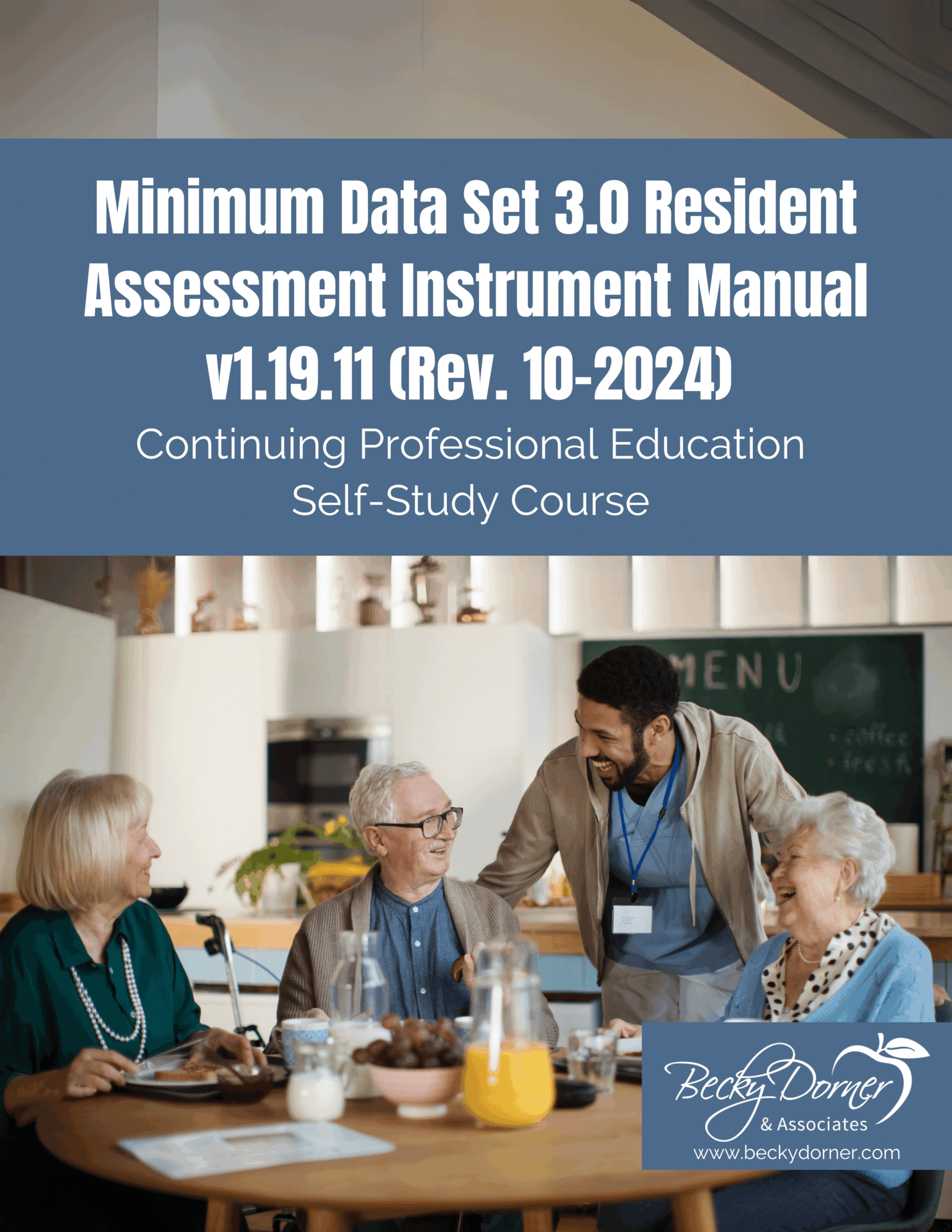
Minimum Data Set 3.0 Resident Assessment Instrument Manual v1.19.1 (October 2024)

Course Expires December 18, 2027
Credits: 12 (1 Ethics CPE)
Profession:
RDN/NDTR
Required Reading 1
Purchase this Product
Revised for v1.19.1 (October 2024)!
This is the perfect course for RDNs and NDTRs who work in long term care. Stay up to date on standardized protocols in the MDS 3.0 RAI. BONUS – this course provides the required Ethics CPE!
Bonus! Buy this course and receive the webinar below for FREE!
This course is based on the Centers for Medicare and Medicaid Services’ (CMS) Minimum Data Set (MDS) 3.0 Resident Assessment Instruments (RAI) Manual (v1.19.1 October 2024 revision) which is a document used for implementing standardized assessment for facility care management in nursing homes and non-critical access hospital swing beds. The purpose of the manual is to offer clear guidance about how to use the RAI correctly and effectively to provide appropriate care and create an individualized care plan for each resident. It also assists in tracking changes in the resident’s status, evaluating goals, and revising their care plan.
The RAI provides assessments for each resident’s functional capabilities and helps facility staff identify health problems. The assessment is performed on every resident in a Medicare and/or Medicaid-certified nursing homes/facilities. The MDS 3.0 tool includes the individual resident in their assessment process and focuses on standardized protocols. The care plan is then developed as a resident’s path toward maintaining or achieving their highest level of well-being. The RAI manual is composed of three areas: The Minimum Data Set (MDS) Version, the Care Area Assessment (CAA) process and the RAI Utilization Guidelines.
The MDS Assessment data calculates the resident’s Patient Driven Payment Model (PDPM) classification for payment. The PDPM case-mix adjusted groups are determined using extensive information on the resident’s therapy and nursing needs, including ADL status, cognitive status, behavioral problems, and medical diagnoses. Coding Section K accurately will affect the PDPM score, including parenteral IV feedings/fluids and tube feedings. This is covered under PDPM non-therapy ancillary (NTA) services. Malnutrition is also captured using this system under the NTA comorbidity score calculation.
This course is appropriate for registered dietitian nutritionists (RDNs) and nutrition and dietetic technicians, registered (NDTRs) that are employed in skilled nursing facilities regulated by the Centers for Medicare and Medicaid Services. RDNs and NDTRs can benefit from reviewing the entire MDS manual to be familiar with the entire MDS. A continuing professional education case-study based exam helps the reader apply the information in the required reading to their work setting.
Course includes eDocument (including a link to the required reading in the course document), electronic test and 1 certificate with passing grade.

After completion of this CPE program, the participants will be able to:
- Integrate new knowledge and skills related to the MDS into practice.
- Keep abreast of and complies with national regulations, policies, and standards for completion of the MDS.
- Use established benchmarking and best practices to inform practice in CMS regulated skilled nursing facilities.
- Prioritize specific nutrition problems to inform nutrition care plans.
This course is intended for: RDNs and NDTRs
Minimum Data Set 3.0 Resident Assessment Instrument Manual v1.19.1 (October 2024) Course awards 12 CPEUs in accordance with the Commission on Dietetic Registration CPEU Approval.
*Please note this course has also been approved for the required 1 ethics/health equity CPEU.
CDR Activity Number: 186290 Self Study Activity Type: 741 Enduring
CDR Course Level: II
Suggested CDR Performance Indicators:
- 1.1.5 Integrates new knowledge and skills into practice.
- 1.2.2 Keeps abreast of and complies with national, state, and local legislation, regulations, policies, and standards.
- 8.4.7 Uses established benchmarking and best practices to inform practice.
- 11.3.3 Prioritizes specific nutrition problems to inform nutrition care plans and processes.
Note: Numerous other Performance Indicators may apply.
The Academy of Nutrition and Dietetics (Academy) and Commission on Dietetic Registration (CDR) are not responsible for the provider’s interpretation of the Academy/CDR Code of Ethics for the Nutrition and Dietetics Profession or its enforcement as it relates to the scenarios and content presented in this activity.
This self-study course includes required reading, a downloadable course document and an online exam with multiple choice, case study based questions. Upon passing the test, the learner can download and print the certificate.
Required Reading for this Course: The MDS 3.0 RAI Manual v1.19.1 is a Centers for Medicaid and Medicaid Services (CMS) Publication (a link to the document is included in the downloadable course document).
Disclaimer: The text associated with this course is required solely for the course taker to learn the underlying principles that will be applied in taking a case-study based exam. Neither the authors nor the publishers of the text/book have contributed to or endorsed this course.
Praise for Becky Dorner & Associates
This course provides the most current and pertinent information on the consumption of ultra-processed foods and cognitive health in aging individuals. I haven’t seen much information on this subject matter and every RDN should add this to their education arsenal.
Ultra-Processed Food and Older Adult Cognitive Health Self-Study Course
Sue Linja, RDN, LD
Becky Dorner & Associates programs offer valuable courses for staying current and applying evidence-based practices in various care settings. The course “Top Strategies for Nutrition and Brain Health for Aging Adults” provides learners with an overview of top trends to deliver quality…
Top Strategies for Nutrition and Brain Health for Aging Adults Short Course
Doreen Rodo, MEd, RDN, LD
Due to the growing rate of food allergies not only in the United States but worldwide, this course is vital to the education of current and future nutrition professionals.
Nutrition Management of Food Allergies Course
Lisa Cooperman, MS, RDN
Continuing education programs from Becky Dorner & Associates are always high quality, evidence-based and timely. Given how fast information can change, it is critical to know that you are receiving information that will help you in your present work but also help…
Kathleen Pellechia, MS, RDN, PMP
This self-study course uses the most current and comprehensive guide on the subject of food allergies for nutrition professionals. The material created to evaluate practitioners understanding of the content is an excellent Level II CPEU course!
Nutrition Management of Food Allergies Course
Eva Weston, RDN, LD, NBC-HWC
BD&A is the best CPE provider! Their courses and webinars are top notch and so is their customer service!
Best CPE Provider
Suzie Dorner, RN, MSN, CCRN
Popular Products
✨ BOGO!